Someone Became A Reader Today

Someone became a reader today. On his mother’s lap, with his favorite book. A book whose cover is worn by many bedtime stories and look-throughs. He loves the colors, and he loves the pictures, and he loves the story. He may not know the words yet, but he can look at the picture of the girl and know that she is sad that she lost her dog, like the story says. He can recite the words he’s heard over and over, night after night. He can tell his favorite parts, and he can say what he thinks will happen next. He has connected with the book and the story and the characters, and he wonders if there are any other books about dogs that he could look at. And there was no worksheet, and there was no grade…but today, someone became a reader.

“Children are made readers on the laps of their parents.”– Emilie Buchwald

Someone became a reader today. In her teacher’s classroom, in a cozy nook,  with her “just right” book. A book that she chose because the choice was given. She likes the cover, because the character on the front looks like her and that makes her feel important. She opens the pages and is drawn into a world of fairies and princes and dragons, and she is sad–SAD–when the class has to move on to another activity and she has to close her precious book. “Later,” she thinks. “I can’t wait.” She was given a carefully mapped path by her teacher, she took the steps down that path to choose a book she might like, and she fell in love. And there was no talk of level G or H or N…but today, someone became a reader.

Reading should not be presented to children as a chore, a duty. It should be offered to someone as a gift.” –Kate DiCamillo

Someone became a reader today. At the kidney-shaped red table, with a teacher who has planned and prayed and cried and tried again and again. A teacher who decided that she will not give up on this boy. He waits for his signal to come and sit at the table with the teacher, and he looks forward to it because he knows the teacher loves him. He knows that she is not going to give up on him. So she calls and he comes over, and at some point during the lesson, a light bulb just “goes off,” and he starts putting sounds together, and things just start making sense, and the story comes to life for him. His teacher gets really shiny eyes and claps her hands and cheers for him. He is so excited that he asks to read some more words. And there was  no timer …but today, someone became a reader.

So it is with children who learn to read fluently and well: They begin to take flight into whole new worlds as effortlessly as young birds take to the sky. “–William James

Someone became a reader today. In a library. In a bookstore. A grocery store bookshelf. A thrift store. A yard sale. They pick up book one in a series that has just been waiting for them. “Maybe I’ll read this,” they think absently. But they go home and have a second, so they sit down and open the book. And the rest is history. The characters become real. The pages are flown through, but the reader is sad when the pages are gone. Laughter bubbles over, tears flow freely, and the heart beats fast. Book one turns to book two, then book three, four, and on it goes. And there was no assignment, no test…but someone who always said they don’t like to read became a reader today.

There is no such thing as a child who hates to read; there are only children who have not found the right book.”–Frank Serafini

You never know when your path will cross with someone who is just waiting to become a reader. You don’t have to be a teacher to inspire a rising reader. Watch for them, offer book ideas and suggestions…because it is never too early or too late for someone to become a reader. It happens every day.

closeup photography of book page folding forming heart

Photo by RAHUL on Pexels.com

Posted in Uncategorized | 4 Comments

Teaching Kindergarten: 6 Ways To Promote Great Writing

It’s an amazing blessing to have a front row seat to the transformation that takes place in a kindergarten student’s communication skills. Some come to the classroom with very few words in their spoken vocabularies and leave for first grade not only with a wide bank of oral conversation skills, but as writers.

When we are able to unlock the door to writing, we introduce our students to a whole big beautiful world of storytelling, sharing, learning, expressing, and communicating. The possibilities become endless.

“Good morning! Today is Friday, 2014. No one is absent. I like hunting.”

But how do we get our little ones from the preschool babies who walk in our door in August to the authors who leave us in May, ready to take the written world by storm? I’ve had thirteen years to work on this, and I’m still learning every day! After years of trial and error, and more error, and some more trial, I have come up with several routines that to me are “must-haves” in my room in order to promote written communication.  The list is not exhaustive–I’d love to hear your ideas in the comments section–but I have found that implementing the following steps make my kindergarten students into writers that I am so proud of.

1. Let Them Talk! And talk some more, and then some more. Letting students talk is a key to oral development, which is the stepping stone to written communication. If young children can’t organize and verbalize their ideas out loud, how can they move on to getting them on paper?

Do you remember being in classrooms when you were young that were so quiet you could hear a pin drop? That’s not how my room sounds. Almost ever. We do have quiet times, and I stress the importance of quietness in certain situations, but I recently took serious consideration of the times that I required quietness in my room and my reasoning for the lack of communication. I found ways in my schedule where I could promote more conversation, and my students’ writing improved because of it. (Read more about promoting oral language in kindergarten here.) Once my students became accustomed to sharing ideas aloud in different school settings, it became natural to get those ideas on paper, and their communication expanded from speaking to drawing to writing symbols and words.

2. Let Them Draw! At the beginning of the year, I provide as many opportunities for my students to practice drawing as I can think of. We draw on whiteboards, magnadoodles, stationary, construction paper, the table (with dry erase markers–hey, it comes off!), in notebooks. I am constantly collecting little tablets of paper, stencils, markers, and pens to use in drawing activities, which eventually become writing activities.

Now, sometimes I do directed art and drawing activities, but that’s not what I’m talking about here. These drawing opportunities are not directed, except for the fact that the students have to draw the entire time that is designated. I always tell them that when they think they are done, they can add more details or more colors to their pictures. I also tell the students to use only one sheet of paper so that they can practice being focused on one “story” in their drawing. Later in the year, when students are writing long stories, I let them use as much paper as they need, but in the beginning we limit our drawing to one page in order to build discipline and organization to our ideas.

So when do we have time to “just draw” in our day? I have made several drawing stops in my schedule that eventually turn into writing stops. Here they are:

  • Morning Activities- After unpacking, students can draw in their journals or on special paper. At the beginning of the year, I specify the type of paper and provide special drawing tools like glitter pens, markers, etc. for students to use in enhancing their pictures.
  • Literacy Stations- One of our literacy stations is called “Work on Writing”, and at the beginning of the year, we simply draw during this station. This is a favorite for all students, and they especially enjoy sharing their drawing stories, which is an essential step to “writing more”, as I will point out later!:)
  • Math Stations- Students love to draw the things they have created at block stations, the puzzles they have completed, and the colors and shapes that they have sorted.
  • Science Reflections- We draw our predictions and conclusions several times weekly for a number of science experiments. Note: This is an exception to the “non-directed” drawing, as I do provide a prompt for the drawing.
  • Social Stations- In my class, when we do Social Stations–some call these Fun Stations or Play Stations–drawing is always a choice. It never grows old! By providing new and fun drawing tools throughout the year, students never get tired of the opportunity to draw.

It makes me so happy to see students in kindergarten progress beyond pages full of scribbles to pictures with details, with structures, with organization. Pictures that tell a story. Pictures that are waiting on words!

This is a drawing from August. You can clearly see two friends. The author added details like a sun and grass. This is a drawing from August. You can clearly see two friends. The author added details like a sun and sky.

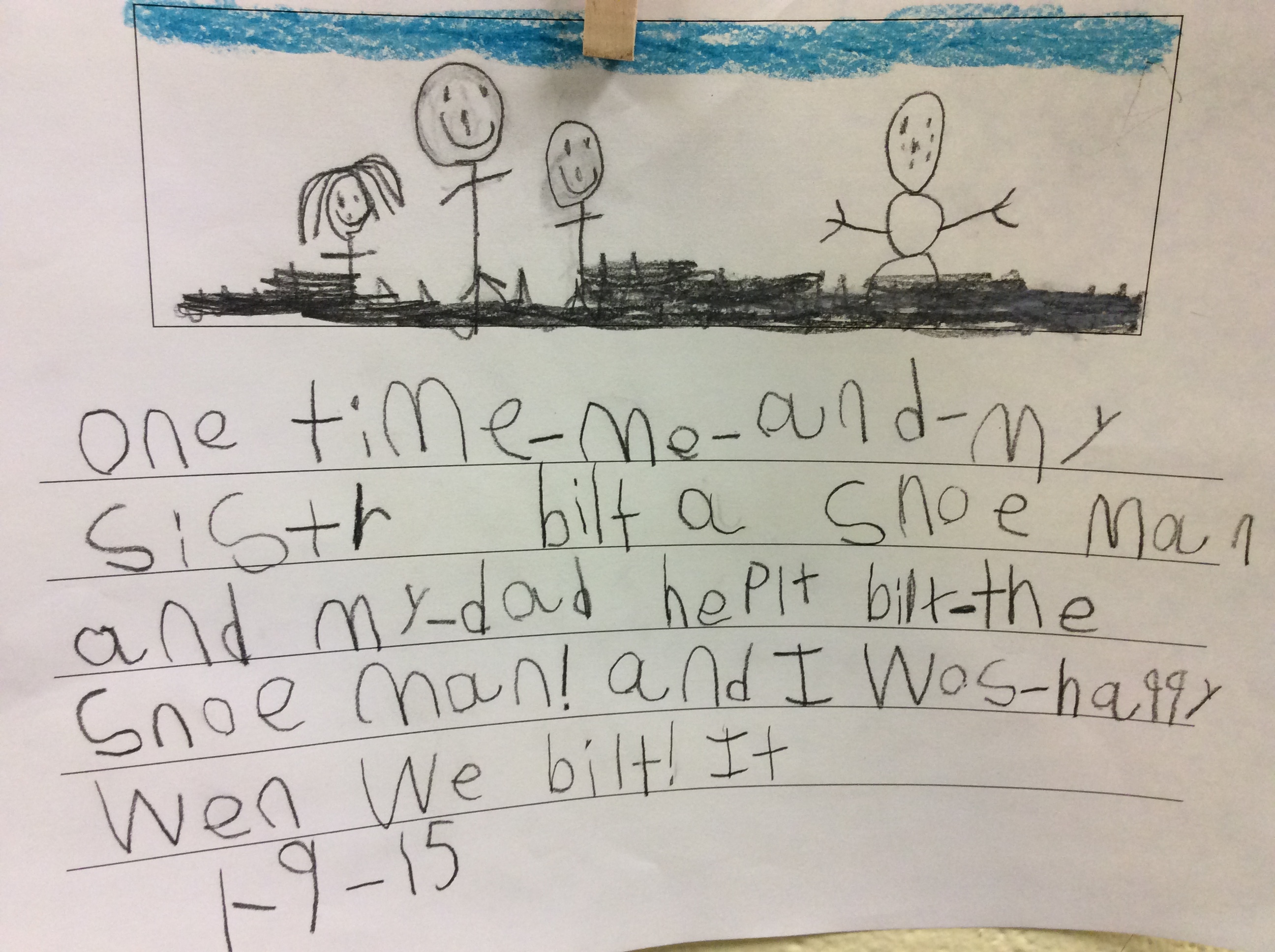
3. Let Them Write! Okay, there’s no magic date that we change over from drawing pictures to writing words in my classroom. Sometime in September though, I gather everyone around on the rug and do one of the most important lessons of the year. It’s the “Let’s Add Words” lesson! I very excitedly point out that we have been drawing some marvelous stories with lots of details and colors, and now that we are learning our letters, I think we should add some words to our stories. I tell my students that from now on, I’d like for them to add words to all of their pictures that they draw. At first, they may only want to write one word on their story, or a few labels. We have several lessons where we learn what labels are and then the kids go on a labeling spree for about three weeks in which they want to label their entire world…it happens every year! Then one word gradually turns into a few words, and then a sentence. Eventually, with some listening and prompting, a sentence turns into two sentences, and then a paragraph, and then a story. And I am always overwhelmed and amazed by the ingenuity and creativeness that grows before my eyes.

IMG_3563 “I see a rainbow. It has colors.”

IMG_3564

4. Model, Model, Model. So, kindergarten teachers actually have two jobs. We are not only teachers–we are supermodels! One of the best ways to teach students to do what we want them to do is to show them by modeling. When I start a writing lesson with my students, before I send them off to their spots for writing, I model my own thinking and writing. Take the lesson mentioned above, for example. Once I’ve told students that we are going to start adding words to our story drawings, I model. I go to my big board or big paper and model my drawing first. By this point in the year, students are used to my modeling and they eagerly watch and add tips and pointers to my drawing, like “Add more colors!” or “You need to put some grass on the ground…and a cloud in the sky! Maybe you could draw a leash from your hand to the dog.” When the picture is complete, I show them how I would add some words. This may seem like an oversimplification, but I have learned from experience that the more I model, the more they write. So I go through the process of thinking aloud. “Let’s see…what words could I write about my drawing? What’s happening in the picture? Oh, right. I’m walking my dog outside. Hey! I could write that!  I…aaammm(that’s me sounding out the word ‘am’)…wolkeeng….my…dog.” As I model, I spell the words the way they sound. This helps the student who is a perfectionist and only wants to write words that he/she can spell. When they realize that I am giving them permission to spell the words as they sound, they seem to relax and write more freely. I always take my writing down when I send the students to their chairs to do their own writing. They may use my modeled idea for their own story, but I want them to use their own words.

As the year goes on, I let students model by sharing their work with partners, small groups, or the whole group. This provides extra motivation and inspiration and seems to give students the extra boost to write more.

IMG_3562 “I like the fire station. It is going to be fun. We are going at 9:00.”

5. Listen To Them. This was a skill that took years to cultivate. I still strive to be a better listener to my children. The more I know them and their interests, and the more that I listen to them, the easier it becomes to help them get started with ideas for writing. It gets easier to encourage them to write more once they get started.

Once I’ve sent students to their writing spots to draw or write stories, I circulate the room and conference with students individually. Sometimes conferencing simply involves me listening to the student’s ideas for their story and giving them the thumbs-up they are looking for. Other times, conferencing is a quick answer to a question. “What two letters make the /sh/ sound? Does ‘kitten’ start with a c or k?”

But sometimes conferencing involves some very close listening on my part. When a student just has a few hastily marked items on their sheet of paper and they don’t know where to go to form a story, when a student wants to draw a flower and label it for the sixth day in a row, or when a student is seriously struggling with getting their thoughts from their head to the paper at all, they need a conference to get started. Then, conferencing requires me to listen, encourage, and give direction. “Hey, I’ve noticed you’ve drawn a flower every day this week. Let’s do a different story. Hmmm. What did you do last night at home? You played with your sister? Was it fun? It was?!? You should write about that! Let’s see…so you played with your sister. Maybe you should start there? Okay, let’s go…I plaayyyeedd…” And we go from there.

There will always be a student who needs the teacher to get him or her started from square one. I have found that conferencing is the key to this. Conferencing and listening help me to know so much about the child’s abilities and interests. This is an invaluable tool for teachers and students alike.

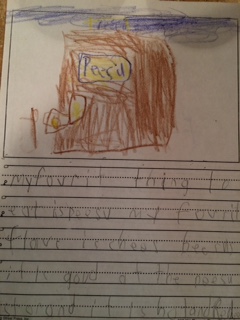
FullSizeRender (6) “My favorite thing to eat is pizza. My favorite flavor is cheese because it is good at the pizza store and it is hot and ready.”

6. Make It Fun! There are things you can do to spruce up writing opportunities throughout the year. Novelty items like special paper, notebooks, pens, markers, stencils, stickers, desks, and envelopes just make writing more fun and exciting. Involving writing in different tasks like block-building, art, experiments, and even the Home Living station can invigorate students’ creative juices as well (for more on writing in the Home Living station, click here). Finally, making a big deal of publishing students’ writing is a huge motivation factor. I like to have a Writer’s Corner or some type of special display for students to showcase their favorite pieces. I also include special sharing times in my daily schedule when students can share their stories with peers.

This lap desk can be used anywhere in the room. Students love using it in a quiet corner to compose their stories. I fill the sides with markers, pens, and crayons! This lap desk can be used anywhere in the room. Students love using it in a quiet corner to compose their stories. I fill the sides with markers, pens, and crayons!

I’m sure there are so many more ideas to help our students become writers in kindergarten. For me, the ones above have been fool-proof, child-proof, and crazy day-proof. These routines have been imbedded into our days at school, and as a result, I have seen growth in my little writers that astounds me and humbles me all at once. I am glad to have played even a small part in facilitating what I pray will be a lifelong love of writing and learning for my students.

morning station blog pictures 009

What about you? What has worked in your classroom or home for promoting writing with your little ones?

Posted in Teaching | Tagged , , , , , , , , , , | 13 Comments

Teaching Kindergarten…Keep The Home Living Station!

I remember my first day of kindergarten. I was sort of indifferent about school…I didn’t know what I was getting into, so I just followed my mom into the building. However, once I realized she was leaving me there, I quickly decided I didn’t want to stay. There were some tears and anxiety…and then I saw the “play kitchen”. Seeing this familiar fixture brought me so much comfort, and even excitement, and then I was okay. Really, I was good to go. And the rest, as they say, is history. I’ve been going to public school ever since!:)

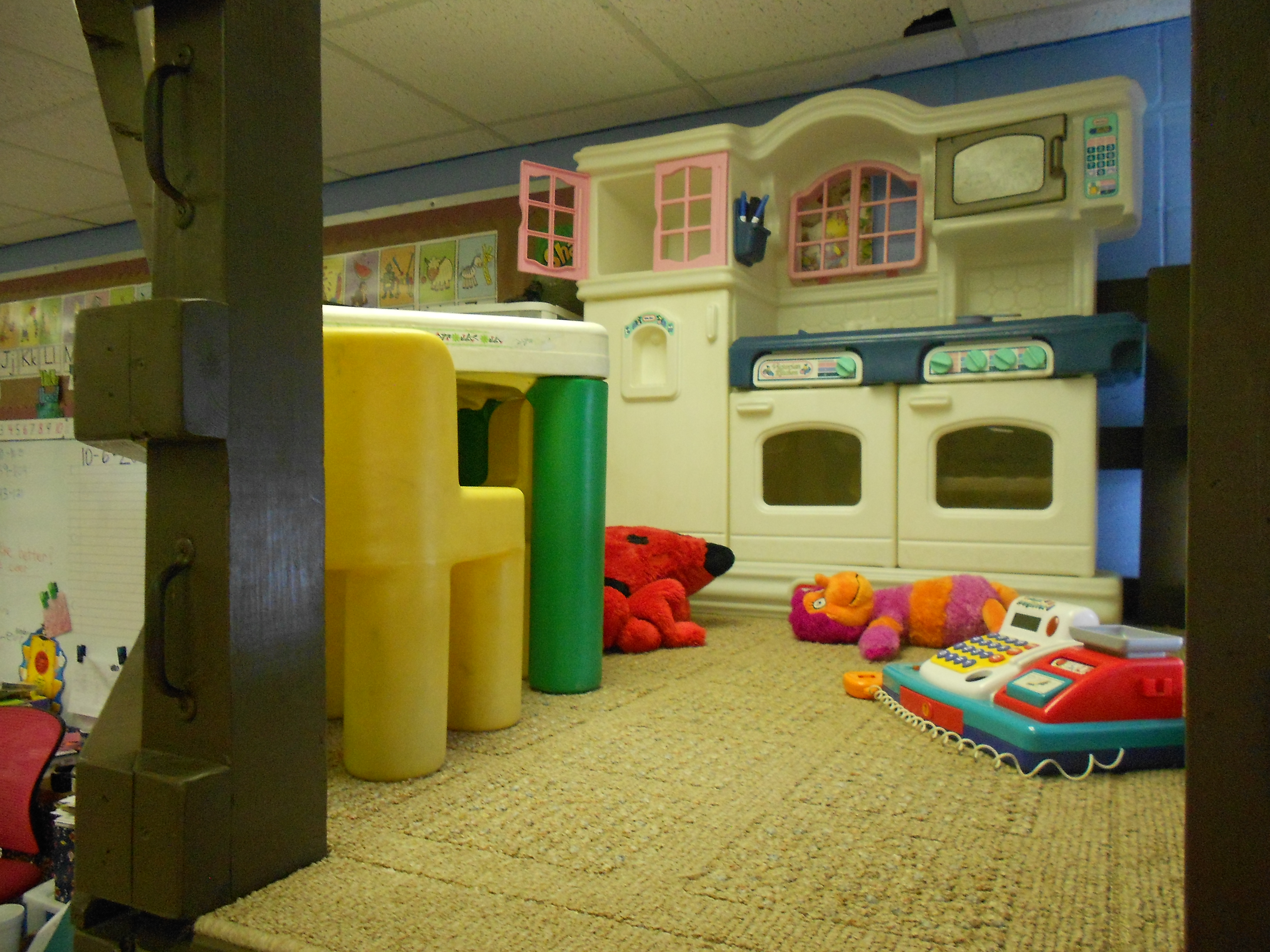
kitchen one

When I was a five year old kindergarten student, K-5 was actually all about learning to come to school. We learned social skills like how to share, how to help others, how to be a friend. We learned the importance of keeping up with our belongings, taking care of school property, and working with our emotions. We learned how to get along. We learned how to be a student.

Now kindergarten is still a very important avenue for learning social skills, but we are also learning to read (pretty fluently), write stories–both realistic and fiction– and to add and subtract by the end of the year. I don’t know about  other kindergarten teachers, but I have found myself in a place before where I have forsaken the importance of teaching social skills in order to teach more reading, write more words, and add more numbers. I’ve spent more time blending and segmenting phonemes than I have teaching my kids what to do if they have to share a toy.

And I wonder why they bicker. I wonder why they tattle. I wonder why they have one crayon left in their pouch after just a week of school (Teacher, I don’t have a red…or a blue…or an orange…).

I know I’m not the only one wondering. In talking with teachers in many districts, I’ve discovered that there is some concern with the social skills of our older students in schools today. Bullying is becoming a presence that needs to be dealt with. Not only the bully-er, but the bully-ee (Did I just make up some words?). Older students don’t know how to treat each other anymore. They haven’t had lots of practice with sharing, speaking, listening, and working with one another in a non-academic setting. Some students are “being mean” to get attention, relationships (what they think is a relationship), and acceptance. Other students don’t know how to react to someone treating them in an unwanted way, and they are dealing with anxiety that comes from not knowing how to deal with different people.  I think one way to help this situation is to give students more time to have social interaction when they are young. Before they become self-conscious and create different stations and groups among themselves.

I was on a vertical Language Arts team for my school for two years and we worked very hard to align our curriculum with the new College and Career Ready Standards for English Language Arts. One of the main topics we discussed and worked on was vocabulary. We looked at the research about the importance of teaching our children Tier 2 and Tier 3 vocabulary words. Tier 2 words are high-frequency vocabulary words that may or may not have multiple meanings, like savor or ability. Tier 3 words are lower-frequency words that are specific to a certain context (the words  you used to write down and define in biology class). As the discussion went on, I agreed that instruction on these words was so important. It’s needed. But I had a growing sense of urgency about another type of words that I realized many kindergarteners were lacking, Tier 1 words. I, along with other teachers in my school and other schools, was focusing on teaching these wonderful Tier 2 and 3 words when I had kids that didn’t know what friend, baby, and sorry meant. I had kids that didn’t understand the meaning of beside, below, above, and in front of.

So I really started thinking about my teaching of social skills and what I call “social words”(this is just a Paige Givens term, not fancy or official by any means). How could I teach my kids these words and skills in a natural, authentic way?

The answer was right in front of me, in a sunny corner of my room, begging not to be thrown out, as so many kindergarten teachers are being pressured to do. It was my kitchen!

You may call it the Home Living Station, or the Dramatic Play Area, or  Houseware Center. You may call it “Who has time for that?!? I got rid of that years ago! Too busy.”

But I am here to advocate for the Home Living Station! There is a place for it in your curriculum! Your kids need time to play and talk with each other. They need space to make believe and work together to make their imaginations come to life. They need opportunities to practice sharing and “working it out” when there are not enough supplies to go around. They need opportunities to disagree.

A few years ago, I brought my Home Living Station up to speed with vigor and excitement. I decided to use it as a teaching tool during my Literacy Work Stations (YES, during Literacy Stations!), and started off the year with a few kitchen utensils, plastic foods, and baby dolls. I have found that if I use fewer props at the beginning, it’s easier to teach how to clean up and it leaves room for more language exchanges. I also use lots of modeling at the beginning of the year for  having nice hands, words, and feet at the Home Living Station. I have found that the Home Living Station is one of the greatest opportunities for the speech pathologist to work with students who are acquiring language skills. It’s a natural, authentic environment for students who need extra support in developing oral language skills.

I focused on three Kindergarten College and Career Ready Standards when designing my new Home Living Station a few years back. These are the ones I’ve been using:

 Describe familiar people, places, things, and events and, with prompting and support, provide additional detail. (CCSS.ELA-Literacy.SL.K.4)
 Add drawings or other visual displays to descriptions as desired to provide additional detail. (CCSS.ELA-Literacy.SL.K.5)
 Speak audibly and express thoughts, feelings, and ideas clearly. (CCSS.ELA-Literacy.SL.K.6)

I divide up my Home Living Themes by the month most years. Here are my plans for Home Living each month of the school year. My wonderful kindergarten teacher partners at my school collaborate constantly to improve our stations. They’ve graciously included pictures of their Home Living Stations.

August

“My Home”- we are just learning to come to school, so this month is all about learning how to use the materials at home living. We do lots of modeling and practicing. The Home Living Station is usually everyone’s favorite station to choose (both boys and girls).

“School”- I bring in a “big kid” desk and set out books, pointers, pictures, and different items for the students to teach with. They love to decide who is the teacher and who are students. I hear my own words coming out of their mouths when they are playing school. 🙂

September

“Grocery Store”I have parents send in empty cereal boxes, snack food boxes, cleaned out milk cartons, etc. We label each item clearly and students work at the grocery store to make a grocery list by copying the labels onto their list paper. They use pretend buggies and cash registers to act out buying their grocery list.

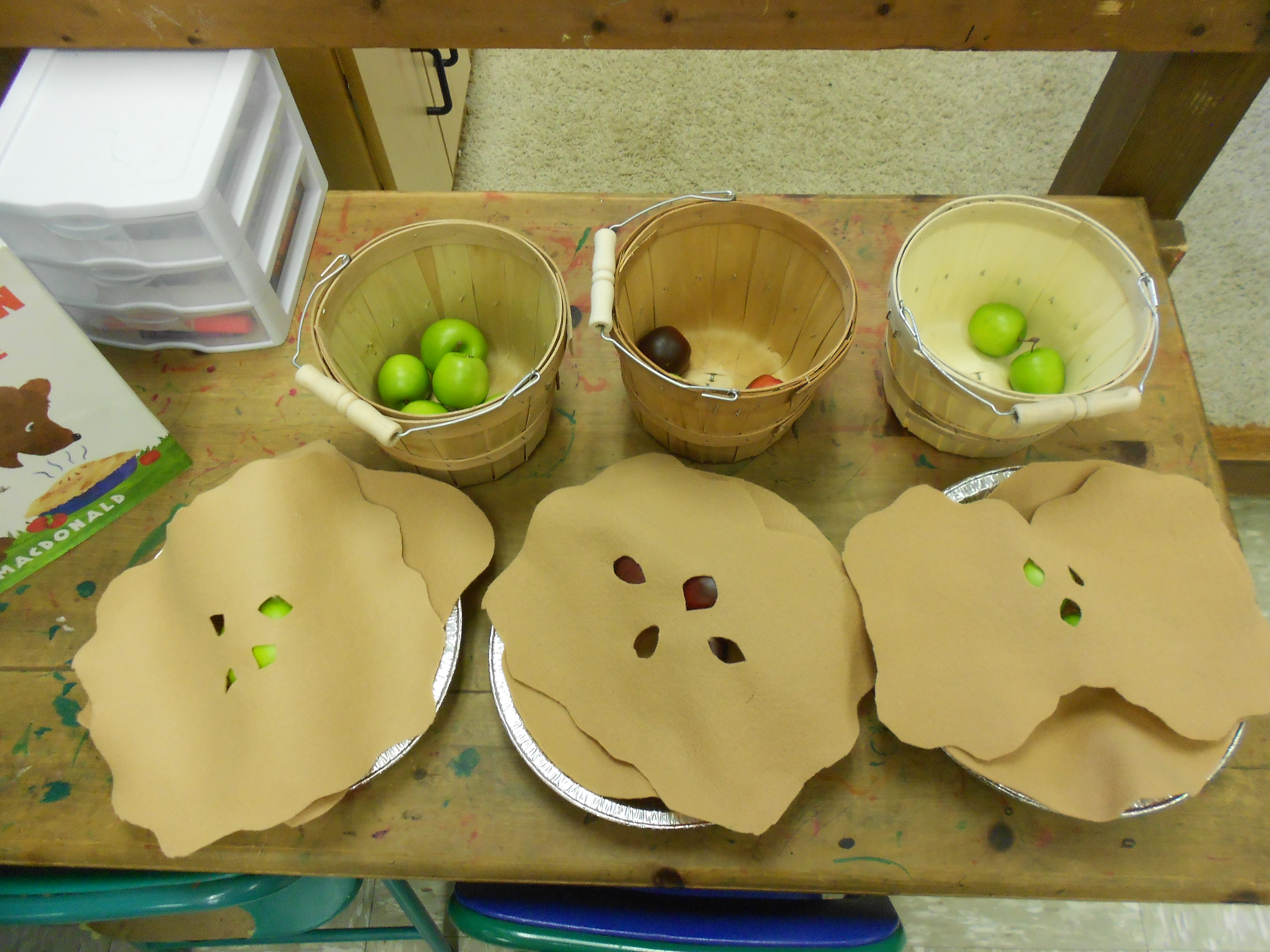
“Apple Orchard”- My teacher friends Lori and Connie created an apple orchard in their classrooms this year with some plastic apples, pie tins, felt, and baskets. The kids LOVED it!

ao                              ao2

Posted in Teaching | Tagged , | 11 Comments

Sincerely, Your Little One’s Teacher

It’s getting closer and closer. The back-to-school ads have started appearing. The school supply lists have exploded in the front of Walmart. The backpacks have gone on sale. Your friends are squeezing in one last quick trip to the beach and your teacher friends are starting to go and work in their rooms.

While the actual summertime season doesn’t come to a close until mid-September, in the South, summer activities are coming to an end.

For parents of kindergarten children, the end of summertime signals the end of something much deeper and more significant. While kindergarteners are often the “babies” of the school, this first year marks the end of a child’s “babyhood” at home. And for many children, school begins even earlier than kindergarten. Most schools are welcoming three and four-year-olds into new preschool programs in public schools these days. Even though this time is very exciting to parents and children alike, it brings out feelings in parents that were hiding under the surface all along. Believe me, I’ve been there–twice. I wasn’t prepared for the onslaught of memories, misgivings, and emotions that washed over me as I watched my little boys walk away from me and into the room that would be their home away from home for the next ten months.

Nothing–absolutely nothing–has changed my teaching more than becoming a parent did. Parents, I have been in your place twice. I have let go of my little boy’s hand and put it into the hands of another woman, trusting that she will love him the way I want her to. I have said a private goodbye to their preschool years, knowing that in some ways their time of “littleness” was going to be over forever. I have come to the realization that in the matter of a few steps, my children have stepped away from a world where Mommy knows best into a world where someone else was going to know best sometimes.  I have swallowed tears of wistfulness, wished for just another few weeks of “the way it was”, and had to physically make myself turn away from my boys as they cheerfully (or stoically, for one of them) waved good-bye to me.

I have been in your place, parents. Fortunately, my children have been blessed with absolutely wonderful teachers. Not only have my boys learned from these ladies; but I have learned too. I have learned things that have changed the way I teach and the way I think about teaching. I’ve learned things that change the way I think about the parents of my students.

There are some things I want you to know, parents.

When you cry, I cry. This may not be true for every teacher, but on that first day of school when you are dropping them off at the door and you start to tear up, I do too. Because I get it.  I know how you feel. I’ve  just come from dropping off my kids, too! 🙂  In the middle of the year, when you come to me  in tears because your home life is falling apart and the child that makes us have common ground is suffering for it, I cry too. Maybe not in front of you, but when I go home and pray for you, I shed tears for you all. When you leave a parent conference in tears of triumph because that child we thought wouldn’t make it to the next grade is progressing, know that I have cried tears of joy as well. And at the end of the year, when you want to say things that just won’t come out because you don’t know if you’re sad or happy, so you just cry…yeah, I do too. A lot. Sometimes embarrassingly so. My fellow teachers and I get together once the year is over and discuss which of us cried the most. We know how you feel, parents, and we feel it too, even when there are no words.

I’m going to be in your corner. I’m not here to work against you. I am for you. It’s not a cliché to me when I tell you that I want us to be partners in your child’s education. If I didn’t mean it, I wouldn’t say it. I want to work with you. Together, we will make your child’s year at school a wonderful success. If there is a behavior problem, I will tell you so that we can figure out together what we will do to help the child. If there is an academic problem, I will tell you early on  so that we can figure out together what we will do to help the child. I’m in your corner, parents. I am for you.

Unless you’re not in their corner. The only thing that will pull me from your corner is if you are not in your child’s corner. If that is the case, I will always choose your child. Always.

I will take care of your child. I promise. It is not a promise I take lightly. I’ve always done my best to take care of my school children’s physical and academic needs. But the one biggest change that came from having children of my own was that I felt very convicted about taking care of my school children’s emotional and social needs. Just covering “the basics” is not enough. If your child comes to me and tells me she can’t find anyone to play with, I will find someone for her to play with. I will also work with her on how to make friends on the playground (a hard task for some children). If your child tells me that some big kids were bullying him on the bus, I will get on that bus and go all  “teacher-ghetto” on some big kids if I need to (my husband will be so embarrassed that I said that:))! If your child can’t get her milk open, I will open it for her. I will work with your boy on how to get that chip bag open by himself, because that is my job. I will take care of your child.

I will make mistakes. I am very human. I am very far away from perfect. I will accidently send your child’s folder home with someone else. I may accidently lose an attendance note or forget to respond to your phone call.  Remind me again to call you. I will make mistakes, but when I do I will do my best to fix them instead of making excuses for them. All I ask is that you are patient with me! 🙂

I will not replace you. No matter how many times your child comes home starting sentences with, “Mrs. Givens said…”, know that they tell me just as much about you. I get called Mama, Nana, and even Daddy on occasion by mistake. 🙂 I know what you make for supper, I know your favorite colors, I know your approximate ages (because sometimes kids think I’m 12 or 89), and I know what songs you listen to on the radio. Know why? Because kids talk out loud about what they’re thinking about. And guess what they’re thinking about? You. Because you are the most important person in their lives. You are the parent and the champion, and I will never replace you. By the way, I won’t tell anyone the embarrassing stuff they pass on. And they do pass it on!

There are many other things I could tell you, but these are the most important to me. Meet the Teacher Night will come, and I will be nervous. I will want you and your kids to like me just as much as you want me to like you! The night is so overwhelming with talk about academics, money, schedules, procedures, and bus routes. There’s no time for me and my fellow teachers to tell you what’s really in our hearts, what made us become a teacher in the first place. So this year, I will just have to show you. It’s going to be a good one.

Sincerely,

Your Little One’s Teacher

school-sign

Posted in Teaching | Tagged , , , , , , , , , , , , , | 16 Comments

If You Give A Teacher A Class List

If you give a teacher her class list, she’s going to want some mailing addresses to go with it. So she’ll dig through mounds of registration forms to find “her kids” and write each address. Seeing all those addresses will remind her that she needs envelopes. She’ll go to the store to get some. At the store, she’ll see the discounts on sunscreen and flip flops and she’ll realize summer is ending. She’ll get sad. So she’ll go over to the shoes to cheer herself up. The cute, strappy heels will give her hope, but then she’ll think about standing in them all day at school. She’ll choose Dr. Scholl’s  instead. On her way to pay for the envelopes and shoes, she’ll pass the Back-to-School quagmire. She’ll get sucked in by the fifty-cent Post-It notes. The Post-It notes will remind her that she wanted to buy 40 of the seventeen-cent notebooks. Just in case. When she’s loading the notebooks into her buggy, she sees the pencils, crayons, pouches, pens, highlighters, and sharpies. She can’t help herself, and in they go. The last thing to go in the buggy is a book of stickers, which makes her think of stamps. When she thinks of stamps, she’ll remember those envelopes and the mailing addresses she needs for “her kids”. And chances are, if you give her mailing addresses, she’ll want a class list to go with it!
If you’re a teacher, you’ve probably read them, but even if you’re not, you’d like these books! 😊


Posted in Uncategorized | 5 Comments

Everyone Falls

“You haven’t ridden your bike in weeks.”

“I’m no good at riding my bike. I keep falling off.”

My son’s big brown eyes asked me to let it go, to not make him try again.

“But everybody falls. You’re not the only one. Everyone in the world has fallen off their bike before. It doesn’t mean you’re not good at it. It just means you’re like everybody else.”

This wisdom from my boy with the big blue eyes.

Everyone falls.

I heard the whisper in my heart as they walked outside to play.

It just means you’re like everybody else.

And I thought to myself, how many of us are still reeling from our most recent fall? How many of us are stunned, laying on the ground, with dirt, rocks, and debris stuck in our knees? With scratched up palms stinging and burning?

A friend said to me one day, “I just don’t think I’m forgivable. The things I’ve said and done–I try really hard to stop doing them, but I can’t control my thoughts. I still think about saying and doing things I shouldn’t do, and sometimes, I just can’t help it and I do the same bad things as before. I keep failing.”

Everyone falls, friends. Me. You. Your parents. Your preachers. We all fall at some point.

I fall daily. My words are too sharp, too judgemental. My actions selfish and–at times–cowardly. I am a sinner, fallen on the ground, aching from many falls.

But there is a Father.

When I was a little girl, I asked my Father to enter my life and clean up my sin. I acknowledged Who He was and is and invited Him to stay. He never left.

When you have the Father, He comes running to you as you fall.

He picks you up, dusts you off, and tenderly ministers to your wounds. He wraps them up in His grace, and when you ask forgiveness, He never brings your wounds back up again.

In Christ, there is freedom from sin. We have all fallen, and being a Christian doesn’t make us immune to falling short of God’s glory.

But we will never fall short of His grace.

And as I thanked my Father for His forgiveness, His grace, and His love, I heard the soft whir of  bicycle wheels as a brown-eyed boy rode by in his newfound freedom.

everyone falls.jpg


“For all have sinned and fall short of the glory of God.” Romans 3:23

“For the wages of sin is death; but the gift of God is eternal life through Jesus Christ our Lord.” Romans 6:23

Take a listen to the song In Spite of Me by Paige Givens: 


Posted in Uncategorized | 1 Comment

Our Classroom Door

I am not a decorator. I repeat, I am not a decorator!

Any good-looking thing in my house is credited to my sisters, who tell me where to put things and how to arrange.

Because I am not a decorator.

This carries over into my classroom, where,  for a kindergarten teacher, I am not a decorator.

However, I AM an organizer. I tend to ponder better ways of managing my materials and space in my room each year, and last year I turned my attention towards my classroom door.

The door whose surface had held no management or organizational purpose for the past 12 years. In a primary classroom, every space matters.

It was time to make the door matter.

My classroom door idea actually started out as a non-idea. While I’m not a decorator, I do claim to be a creative type in other ways. Especially ways that involve a technique called “flying by the seat of your pants”.

A year ago I was covering my classroom door with paper and border (I will admit that this is a chore I detest), and I simply did not know what to do with it. I usually don’t have a decorative theme for my room, but I do like to have an underlying theme of community, friendship, and love in everything we do.

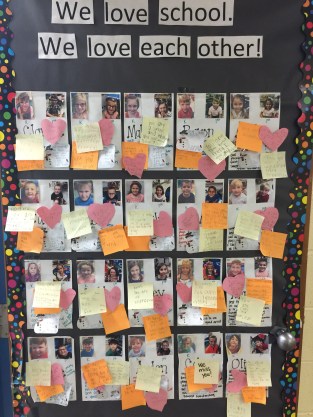
So I was staring at my door, thinking of my classroom of kindergarteners who would be returning to me as first graders (we were a looping classroom, read about it here). We loved school and we loved each other so much. I wanted everyone who came through the door to know how much we cared for one another, and I decided to convey it on my door. I didn’t quite have a concrete plan, but the kids implemented their own plan as the year progressed.

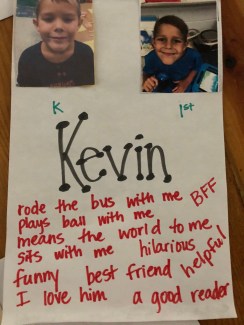
I began the year with a door covered in black paper with a border. On the door, I put the words “We love school. We love each other.” Then, I glued 20 half-sheets of 8.5 by 11 inch paper. I wrote each student’s name at the top of a sheet. Since I’d had them the previous school year, I glued their kindergarten picture in the top left corner of the sheet and l left the top right corner for their first grade picture.

For the first few weeks of school, we spent the last minutes of the school day “speaking life” about each friend. On our first experience, I began by announcing that we were going to tell the school what we loved about each other, so that when visitors walked into the room, they’d see all the good things about us right away. I wondered if I’d need to model a few nice words to get us started.

No modeling was needed. We started with one friend at a time, and the kids called out all kinds of authentic accolades. We were whole group, and I was writing what they called out. I had the warm fuzzies for days hearing the sweet things my students said about one another.

She says nice words to me!

He’s hilarious.

She means the world to me.

He saved my life in kindergarten!  (Say what?!?)

She’s my friend when I don’t have any.

He’s great at math.

Day after day, the children looked forward to this time of day, when we would add compliments to our classroom door about each other. While they were very flattered and excited to hear what their friends said about them, I think the kids were more excited to add compliments to other kids’ pages.

classroom door 4

As the hot summer days faded into fall, the students’ writing became more proficient (they had a writing explosion around October) and it was obvious to me that they should start writing their own kind notes to each other.

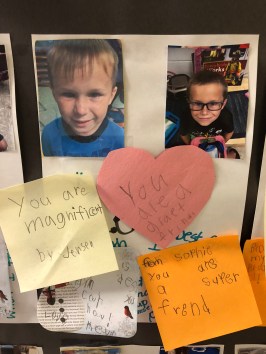
I passed out sticky notes one day and had the kids write kind notes to a friend. I was worried about kids getting left out, so I assigned students a friend to write to. Everyone in our classroom was family…everyone could say a nice word to anybody in the room. That’s how it should always be. So I started out assigning people a friend to write to, and would also take occasions to let friends choose who they would write to. Once the sticky notes were finished, the kids stuck them to the friends’ names on the classroom door. I was very viligant to make sure that each child had the same amount of sticky notes on his or her page.

classroom door

After Christmas, we had a talk about how we were all writing sweet things to one another, but we all seemed to be saying the same things, like “He’s good at reading. She’s a good friend. He’s a good runner.” So we made a classroom list of words to use instead of good. We really focused on the person we were writing to, and we wanted to make our compliments real and authentic.

classroom door 2

Our door became a beautiful representation of the friendship and love between the four walls of our little room.

At the beginning of the year, my classroom door idea/non-idea did not consist of classrooom management opportunities, but as the year went on, I sort of naturally started referring to it during individual conferences with students were having a bad day.

While pulling cards and moving clips and other similar systems work beautifully for other teachers, I chose to use a system of practice-making-progress about five years back. This system has worked so very well for me, but there are always students who seem to have a bad day now and then. Or a bad week. Or longer.

I found myself referring those students to their names on the door. On occasion, I walked that student to the door and read his or her compliments out loud. Sometimes I sent the student to read it alone and quietly contemplate all the good things that we said about him or her.

It always helped. It was so much sweeter, so much calmer, and so much more helpful than if I would bark out something like, “Just come and sit over here by me until you are calm!”

And you know those days where it feels like NO ONE is getting along in your room? Everyone’s going bananas? We had a few of those, of course! I found that I loved going to the door at the end of the day and reading a sweet word or two about each child as he or she lined up to leave for the day. We ended on such a better note than we would have with me giving an ultimatum about how, “Tomorrow better not be like today!”

It’s just a door.

It opens our room up to the world outside of our four walls, and it invites others in.

But this last year, our door space was not wasted. It became a management tool, a writing display, and a pep talk for whoever needed it.

Most of all, our classroom door became a beacon for the students of our class, a favorite reminder to each one that they were unique, they were special, and they were loved.

classroom door 3

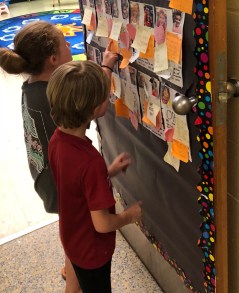
Reading the door was a treasured activity for students as they came in from PE, recess, or the restroom.

So, yes. I am going to do it again for my new sweet kindergarten babies this year.

I cannot wait to decorate our classroom door.

All pictures used with permission. 


Posted in Uncategorized | 8 Comments

In the Midst of the Storm, a Song: Connie’s Story

This was written by my wonderful, beautiful friend, Connie Sullivan, who felt the presence of our Father in the midst of her storm. 

connie

By Connie Sullivan…

For thou hast been a strength to the poor, a strength to the needy in his distress, a refuge from the storm, a shadow from the heat, when the blast of the terrible ones is as a storm against the wall.  Isaiah 25:4

Okay, this is going to be the third of his new treatments.  We have the schedule figured out.

We get there at ten.  Finished around one.  Then, yeah, we are going somewhere to eat. 

We’re still just eating in the car because he can’t get from sitting to standing easily.

But…… today she said his blood work didn’t look right.  So they test again.

How far away do you live? 

About 45 minutes. 

Ok, let’s just take care of this today.  I’m sending you to the hospital for blood after his treatment.

I try to read but I’m restless.  I can’t concentrate.  So I walk.  We’ve been here so many times now I have the path down pat, walking from the professional building through the hospital, down the ramp to the out-patient entrance and back, stopping to ramble through the new gift shop.  Chastising myself for not bringing my new Magnolia magazine to read…

It’s after one when the wheelchair arrives and we head to admitting.

Well that was a breeze for a change.  No waiting, the doctors’ orders are in place and just confirmed that the room is ready.

It’s still just after one.  We’re good.  Should be out of here in a couple of hours.  Chances for going out to eat are possible?

First they take blood to verify type, again.  Every.  Time.  We wait.  They come back to take blood again–not sure what happened with the first tubes.  Our couple of hours is sneaking up on us and we haven’t even started.  We are past tired, hungry, and starting to get curt with one another.  I go get Sneaky Pete’s from the professional building to tide us over.  Maybe that will help us play nice.

Ok, we have O positive

Yep, it hasn’t changed.

Now we wait for the blood to arrive.  And wait.  And wait.   And now we have shift change.  God bless the nurse,  she broke the news that we’re not just getting one but two units AND we have to wait another hour after it is complete to make sure there are no reactions.  Each unit will take approximately two hours.

….but that’s five – FIVE MORE HOURS….  NO. NO. NO…. Chances for eating out just vanished– poof!

Ok we’re looking at nine, most likely ten p.m.  I. AM. TOO. TIRED. FOR. THIS. 

He tells me I need to move the car.  Walking that far in the dark would not be safe.  I make the long trek through the hospital to the professional building.  I want to be as close as I can to the car before having to go outside.  Guess what, every door in the professional building is locked.  I can’t get out.  Sooooo I walk all the way back to the hospital, out the front door.  It’s kind of creepy.  I walk up the middle of the road – no traffic – no people.

It feels like one of those Sci-fy movies…just waiting for some monster to overpower me. 

I hug my arms tightly.  There are eight, yes eight (I counted them four times) vehicles left in that normally over crowded parking lot.  And I got really smart this morning, parking so the pink Crepe Myrtle would be “shade” on the car when we left – at the very end of the parking lot.  UGH!

When I return his hospital supper is served and the blood….

Where is the blood????

Peanut M&M’s – yum, the ones in those little machines – a handful at a time.  Yes, I admit it– I do that twice – but give me a break, at least it was at different times!

The first unit of blood finally gets here.  They start the verification process.

At the end he says, “Lift off!”.  We laugh.  It does sound like a NASA protocol–all those numbers back and forth.  They get it started.  We know it will be two hours.  Our sweet nurse promises she will have the second unit ordered and ready to go just as soon as the first one is completing.  We listen to the steady rhythm of the IV dispenser.

Swoosh…Swoosh…Swoosh…

We lay back and watch TV.  I try to get comfortable in a chair that was clearly made so the one sitting would not wish to stay–hard, rigid.  I get a pillow.  I get a cover.  I try to cover my eyes and lay on my side.  Everything aches, my legs, my side, my head.  About the time I settle down to hopefully just rest so I can drive home, he needs to go to the restroom. Seriously!

I hope I didn’t say anything out loud.  I sling off the cover and slam the chair down.

Did I really just act like that? Ugh!  In the midst of all that craziness, nurses helping him off the toilet, adjusting the bed, turning lights off/down…

A Quiet Voice says, “You did good today.”   My eyes well up with tears.  I bury my head in my pillow.

Thank you Father!  I so needed that. 

I can’t let him see me cry.  He knows what a toll this is taking on me and it bothers him deeply.

Finally the first unit of blood is finished and just as she promised, the second is pretty much ready to go….

Verification….lift off!

We have two hours.  It’s eight-ish.  That means it will be eleven or after before we leave.  We really need to rest just so we can see to drive home.  He says we will never make this mistake again…not in the same day.

Yeah, right.  We never seem to remember the next time or something looks a little different and we fall for it. 

He turns off the TV and we turn the lights off.  The only soft light is on the dispenser.

Swoosh…Swoosh…Swoosh… 

I toss and turn.

He says, Why don’t you just get in bed with me?  You really need to at least try to take a little nap.

I hesitate.

What will the nurses say?

But exhaustion wins.  He scoots over and I climb into to the hospital bed–my head tucked under his arm on his chest.  So close. So very close. So warm.  So safe.   It’s been so long since we’ve been able to cuddle this close.  He’s either sleeping in his chair or on a wedge at home.

Swoosh…Swoosh…Swoosh…

Here we are in the middle of a storm, the likes of which we had never seen.  I can feel something.  There is a pressure on my heart, a shortness in my responses, a tension in the air that is not going away.

And oh how the storm has hit, one round of waves crashing on top of us right after the other.

Broken foot, bone infection, amputation, home-health, chronic blisters, heart attack, cancer, back infection, surgery, home-health, therapy, infection, infection, infection…eight long years…

Swoosh…Swoosh…Swoosh…

About this time last year I was standing in my kitchen screaming at the devil to get O.U.T.  There was so much confusion trying to just get his Chemo meds – it had to be the devil.  God is good all the time.  All the time God is good.

The nodules in his lungs are gone and the groin lymph nodes are status quo – not going away BUT not growing.

Swoosh…Swoosh…Swoosh… 

I used to keep a straight house. LOL! Not clean, but straight.  Right now two of the bedrooms would make any tornado proud of the destruction, dishes are piled in the sink, and every inch of that sweet house needs attention.

Swoosh…Swoosh…Swoosh… 

There are no flowers this year in my garden.  Only the sweet volunteers – a basket of violet Petunias and three Marigolds – weeds and all.  Ah, but the baby birds that nest right beside the front door–the high pitched chirping of four when Mama came to feed-so calming.

Swoosh…Swoosh…Swoosh…

I’ve gained weight – hard not to do when the only thing he wants to eat right now is McDonald’s.  But he’s gained weight.  That is good–a miracle!  The weight he lost was frightening and for a while we were afraid he never would gain.  I tell him if I didn’t have this weight on me, there is no way I could pick him up out of a chair, or car, or toilet or yank the sheet to pull him on his side.

Swoosh…Swoosh…Swoosh… 

I used to remember everything.  A planner, anticipating exactly what was needed next, what was due when, who was supposed to be where…  If I wrote it down on my grocery list, I didn’t even need to take it with me.  But now–well, the other day I almost cried when I realized I didn’t have my grocery list— it’s at home.  We’ll just have to do this another day.  There are so many people barking out things they need – things I forgot. I can’t even think.  I can’t breathe.

Swoosh…Swoosh…Swoosh…

If only I could sleep… I wish I woke up gentle and sweet but I don’t know the person that is waked during the night.  She is not nice.  She is not patient.  She is NOT kind – waking up to turn him over, waking up to cover him up, take the covers off, take meds, and our latest adventure – itching.

Swoosh…Swoosh…Swoosh… 

But I am thankful, the throwing up has stopped and so have the chills and the fever – chills that were frightening.  I have put every cover we have on him and laid on top of him to try to warm him.  But I think when one is chilled to the bone–nothing can help.

Swoosh…Swoosh…Swoosh… 

And then the steady rhythm of the IV Dispenser begins to sing to me. Tears come and go.

When…peace…like…a…river…at…tend…eth…my…way…When…sor…rows…like…sea…bil…lows…roll…What…ev…er…my…lot…Thou…has…taught…me…to…say…it…is…well…it…is…well…with…my…soul…It…is…well……with…my…soul……it…is…well…it…is…well…with……my…soul. 

Slumber comes and goes.

It…is…well…it…is… well…..with…my…soul… It…is…well…it…is…well……with…my…soul…

This turned out to be the last time we were able to cuddle.  He went “Home” before the year’s end…without me.


Posted in Uncategorized | 4 Comments

7 More Weeks

Image result for school images free

The hallway is quiet. The teacher unlocks her classroom door and thinks to herself…

7 more weeks. I can do this. I can! There is so much left to get to. I’m going to have to make every minute count. No days “off”. I’m going to have to use every second to make sure those kids are ready for the next grade. I don’t want them going on with holes in their understanding, with gaps in their comprehension. Wow…I’ve got so much to do in only 7 weeks, and some of that will be interrupted by faculty meetings, PD, testing, and a mountain of end-of-year paperwork. Can I really do this and do it right? I can do this. Okay. 7 more weeks…

Down the hall, another teacher sits at her desk and gazes around her classroom. She thinks to herself…

7 more weeks. 30 years of being an educator, and now it all comes down to 7 more weeks. This room has held my career within its walls. It’s seen the tears, the frustration, the laughter, the wonder, and the joy that comes with teaching and learning. It’s held open the window of knowledge for so many children. Bobby–wow–I thought he’d never start reading, and then, boom! One day, the light came on and he was reading everything he could get his hands on! And then, I taught his boy, and Jenny’s boy, too. I wonder if those kids remember me? I wonder if they know how much I loved teaching them? How they helped me, REALLY helped me,  through those three years that I had cancer? I’m tired. I’m ready for new adventures in retirement, but–goodness–I will miss this room. These kids. I will miss standing at my door and getting hugs and good morning smiles each day. I’ve done it for 30 years, and now I have 7 more weeks…

Next door, another teacher turns on her computers and fumes to herself…

7 more weeks. If I can just get through the next 7 weeks, I will be free of this place, at least for the summer. Free of the pressure. Free of the frustration of giving, giving, giving and seeing nothing gained. I wonder if Sally had her medicine before she got on the bus this morning? Because there is no way I can fight through 7 more weeks of her all day long. I need some help. I’m so burnt-out. Let’s see…I’ve “covered” all of my standards, so I’m going to coast through these next weeks and make them go as fast as I can…

Across the hall, a teacher hums to herself as she posts the day’s assignment…

7 more weeks. I’m going to miss these kiddos. All of them. Yes…all of them! I hope I’ve done what they need every day. I hope I’ve shown them how much I love them! I hope that Ben ate dinner last night, or he’s going to be starving this morning. I’ll need to make sure he eats breakfast either way. I hope that Missie got some shoes that fit her since she is growing so much. Shoot! I should have gotten her some while we were on break…why didn’t I remember that? Well, I still have 7 weeks to take care of these kids. I can do a lot in 7 weeks…

And on the bus, a child solemnly stares out the window and thinks…

7 more weeks. That’s all I get. Only 7 more weeks to call that teacher mine. I only get 7 more weeks to see her smiling at me, to tell her about my days at home, to smell her perfume. I only get 7 more weeks to get some good food for lunch and breakfast, for her to give me a snack. I’m glad she doesn’t fuss at me for not having a snack. I only get 7 more weeks to listen to her read stories. I like her voice. It’s never too loud or too mean. I only get to listen to her for 7 more weeks. I wish we could come to school every day, even on the weekends. Even in the summer. And I wish she could be my teacher all the time. But that’s not how it works. I get 7 more weeks. That’s not very long…

There’s a lot of ways to look at 7 more weeks. How can we make it count?

Posted in Uncategorized | 17 Comments

100 Books A Month

Would it be possible to read 100 books in a whole month? Can you read too many books to a class?

As December was approaching, I was thinking about my reading instruction, especially in the area of comprehension. I was thinking about all of the activities we do in December…the fun things that the kids love, like Santa pictures, Elf Mart, Christmas crafts, ornament making, and many more. I was even thinking about the reading-related activities we do in class, like filling out sheets that correlate to reading strategies, completing practice pages, and station games that may(or may not) relate to a phonics strategy.

I knew that December would be busy and short, and I was feeling like my students’ reading comprehension strategies were fair at best. I read some articles and a few professional books on the subject, and what I came to realize is that the number one most important thing I can do as a teacher to increase reading comprehension is to…well, read. Not just two or three books a day, either. I’m talking about reading a lot of books!

I approached my students with my idea to have read more books in our short-but-full month of December, and they came up with a goal of 100 shared read-alouds.

Whew! Would we have time for this?

We did.

We made time. I really had to look at my reading-related activities and decide the purpose for each and every one. Was the activity necessary? Was it more important than actually reading?

We read 104 books in the month of December, and yesterday, on the last day of January–which was filled with snow and ice days (we came for one whole 5-day week)– we finished our 102nd book of the month. Since the beginning of December, we’ve had 206 shared read-alouds in Mrs. Givens’s classroom.

Today, we had a class discussion about the impact of so much reading in two months. How have we changed? What have we gained? What have we learned?

Here’s what we came up with:

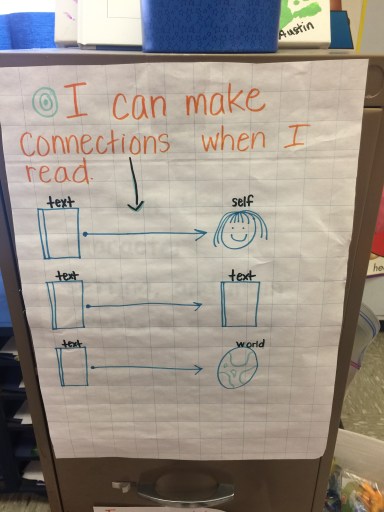
1. We have connected with the books. When you read and read and read, you can’t help but connect to the different texts. The most natural connections, which were connecting between two stories, came swiftly and without effort.
IMG_4267

Hey, this reminds me of Goldilocks and the Three Bears! I think the author is trying to write that story, but with different characters. 

That’s the same guy who illustrated Max and Maggie in Winter. No wonder the pictures remind me of each other!

All of her books have characters who are ducks! That must be her “thing”!

Once I pointed out the connections that were being made by the students, they came even more swiftly. Not only were kids connecting between two texts; they also started connecting the book to their own lives and to the world around them.

This story reminds me of a song I heard on the radio. 

That grandma reminds me of my grandma.

This book taught me a lot about Antarctica. I didn’t know scientists could go there.

The Gingerbread Boy taught me that you should never talk to strangers. They may want to eat you up. <yikes!>

Making connections to a text helps readers to understand the characters, the events, and the outcomes. It simply helps people to become better readers. Our text connections were my favorite part of the 100 book challenge.

2. We have read a variety of books (or as one child said “a varlogaty”).

I have read a lot of books! I’ve read so many that I previously would have looked over in the busy-ness of the day. I’ve found so many wonderful works of literature, and several of my kids have started forming interests and preferences based on authors and styles. It’s amazing to hear their conversations.

I like Mercer Mayer books because I feel like Little Critter is my friend now.

I like to read the Jan Brett books because she writes fairy tales in a new way. I might try to do that during Work on Writing at stations.

I like nonfiction books about animals. I’ve learned a lot about fish by listening to those and reading them myself.

In reading a large volume of children’s books, I’ve learned what I already knew about my own favorite reads as an adult…

Not all books are created equally.

Some books just aren’t that good. The writing is shoddy, the characters aren’t developed, and the story doesn’t seem to complete itself.

Student: I didn’t really like that book. <everyone gasps in horror and looks at me>

Me: You know, you’re not going to like every book you read. Guess what? I don’t like every single book I’ve ever read. Good readers know what books are good fits for them.

We’ve had a whole new revelation in my classroom. Sometimes we are not going to like the book that we’re reading, and it’s okay. However, there are times in life when we may need to read things that we don’t like (college textbooks, account summaries, etc), and we will have to make meaning out of those things. That’s why reading comprehension is so important. And that’s why we need to read a lot to and with our kids.

3. We have learned a lot of new words.

Our vocabulary bank has exploded. We have had multiple natural encounters per book with new vocabulary words. We’ve used picture and context clues to figure out those words, and most importantly, we’ve started using them in our every day speech.

Child (holding up the story The Pigeon Finds a Hot Dog): This book is so inspiring.

Me: Really? Is “inspiring” a word you want to use for that book?

Child: Yes! It inspires me to write a hilarious story…I’m going to call it The Bluebird Found a Corn Dog.

Another Child (with three different tellings of The Gingerbread Man): I think that it is okay to read the same story over and over. I like to read different versions of the same story.

4. We have learned a lot of content.

The amount of background knowledge, vocabulary, and facts that we’ve tucked away is exciting to me. In looking back at our December chart, we discovered that we read way more fiction stories than  nonfiction, so our January goal was to read at least 100 books and texts together, and to make an effort to read more nonfiction stories. My first choices for nonfiction books was informational stories on snow, winter, and polar animals. The kids listened with rapt attention.

I was startled to realize one day that most of my students thought that only books with real photographs were nonfiction books. Many thought that stories with “drawn illustrations” had to be fiction because of the pictures.

This led us into a series of discussions about fiction vs. nonfiction, a concept that I had thought we were solid on in kindergarten. We delved into nonfiction text features as well, like glossaries, tables of contents, and indexes.
IMG_4295

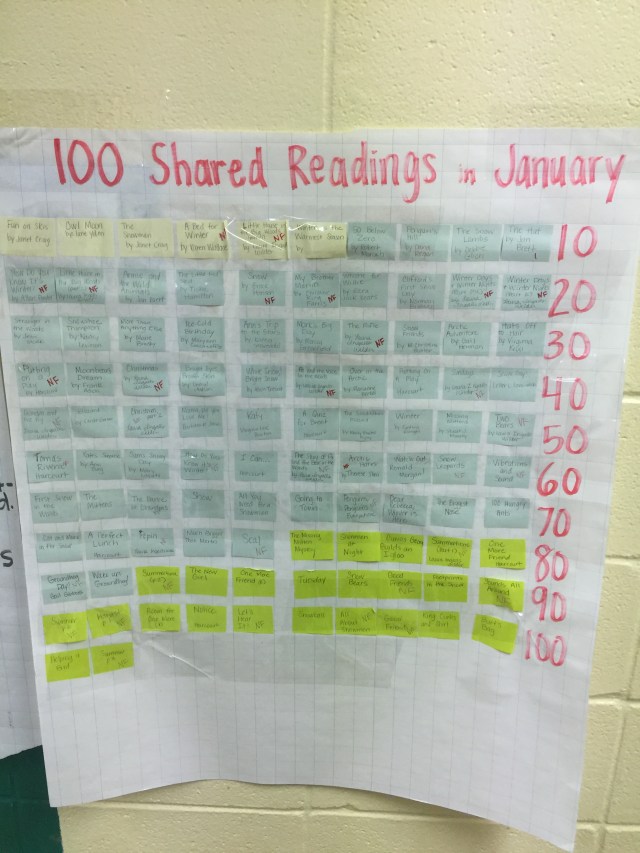
In January, we tried to have a more balanced approach to reading fiction and nonfiction books. We marked our nonfiction books with “NF” by the title. 

Without our 100 Book Challenge, I may never have discovered this misconception among my students about nonfiction and fiction stories.

5. We have developed a love for books and reading.

Sometimes during our literacy stations I will notice how quiet the room has become, and I will look around at my kids. Several will be lounging on their bellies on the rugs, chin in hand, with a book in front of them. Some may be sitting in our tiny chairs, pretending to be the teacher, reading each page and then showing illustrations to their pretend students, stopping to ask  questions about text connections. Others may be writing a response in their notebooks about the last book we read as a class.

These precious moments, if there was nothing else, make our shared reading goals worth reaching.


Questions I’m Asked:

*Where do you get all the books? 

My librarian is my friend!!!! I quickly found out that my classroom library only lasted about a week. While I don’t consider my classroom library small, I definitely don’t have 100 books per month to share.

After reading through my classroom books, I visited our school library, which led our class to about three-fourths of the way towards our goal. Then, I borrowed from other teachers and invited students to bring in books pertaining to our current holidays, themes, and units of study.

Note: I did NOT simply read any random story just to put a book on the board to 100. I was careful to make sure our stories had purpose and meaning.

*How did you count chapter books towards the goal?

I read a chapter a day every day, so I counted each shared reading experience as one shared reading. Our current chapter book, Little House in the Big Woods, has been a surprising favorite for many students who didn’t necessarily look forward to the story at first.

*How many books did you read per day?

5-9

*How did you find time to read that many stories?

We made time. After careful consideration, we did get rid of some busy-work activities to make more time for reading. I also have had to stay on my toes and keep my eyes on the clock in order to make every minute count in my day. I keep my books for the day on a counter behind my “Reading Chair” and the stack itself keeps my mind on our reading goal for the day.

*How do you keep up with how many books you read?

We have a simple chart and some little sticky notes (pictured above). I just write the name of the story on the sticky note and post it! In the future, I plan to let students fill out the sticky notes and chart our titles themselves.


Do you have shared reading goals in your classroom? How do you accomplish those goals? What growth have you seen in your students’ reading comprehension? Let us know!


Posted in Teaching, Uncategorized | Tagged , , , , , | 2 Comments